
Perpetrator Trauma as a Possible Solution for Cultural Trauma: The Case of Joshua Oppenheimer’s The Act of Killing (2012) and The Look of Silence (2014) L'exemple de The Act of Killing (2012) et The Look of Silence (2014), de Joshua Oppenheimer
Article Sidebar
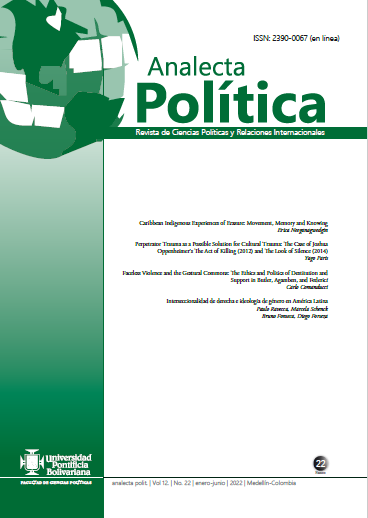
How to Cite

This work is licensed under a Creative Commons Attribution-NonCommercial-NoDerivatives 4.0 International License.
Downloads
Societal impact
Main Article Content
Abstract
The present article analyzes Joshua Oppenheimer’s documentaries The Act of Killing (2012) and The Look of Silence (2014) from the perspective of trauma. The aim of this study is to give new approaches that could allow a deeper understanding of such a complex sociopolitical situation as the one that is taking place in nowadays Indonesia. First, I will introduce the term cultural trauma to explain the situation of the victims of the 1965-66 mass killings that took place in Indonesia. Then, I will make use of the concept of the political taboo to better understand how the official narrative imposed by the government has worked, and still works, as some sort of unquestionable myth. Afterward, I will point out that these two concepts give birth to a vicious cycle from which escaping becomes highly unlikely. A possible solution I propose here comes from studying another type of trauma, that of the perpetrator, since, in an indirect way, it can lead to an improvement of cultural trauma. By approaching trauma in a non-moralistic sense, allowing the perpetrator the status of a victim, I intend to highlight the importance of empathy and understanding in the process of healing of not only perpetrator trauma, but also, and more importantly, cultural trauma.
Article Details
References
Alexander, J. C. (2004). “Toward a Theory of Cultural Trauma.” In J. C. Alexander (Ed.) Cultural Trauma and Collective identity (pp. 1-30). University of California Press. https://doi.org/10.1525/9780520936768-002
Blanuša, N. (2017). “Trauma and Taboo: Forbidden Political Questions in Croatia.” Croa- tian Political Science Review, 54 (1-2), 170-196. https://hrcak.srce.hr/183305
Caruth, C. (1995). “Trauma and experience: Introduction.” In C. Caruth (Ed.) Trauma: Explorations in memory (pp. 3-12). The Johns Hopkins University Press.
Eyerman, R. (2004). “Cultural Trauma: Slavery and the Formation of African American Identity.” In J. C. Alexander (Ed.) Cultural Trauma and Collective identity (pp. 60-111). University of California Press. https://doi.org/10.1525/9780520936768-004
Eyerman, R. (2019a). “Cultural Trauma, Collective Memory, and the Vietnam War.” In Memory, Trauma, and Identity (pp. 143-165). Palgrave Macmillan. https://doi.org/10.1007/978-3-030-13507-2_7
Eyerman, R. (2019b). “Perpetrator Trauma and Collective Guilt: The My Lai Massacre.” In Memory, Trauma, and Identity. (pp. 167-194). Palgrave Macmillan. https://doi.org/10.1007/978-3-030-13507-2_8
Giesen, B. (2004). "The trauma of perpetrators." In J. C. Alexander (Ed.) Cultural trau- ma and collective identity (pp. 112-154). University of California Press. https://doi.org/10.1525/9780520936768-005
Krstic, I. (2002). "Re-thinking Serbia: A psychoanalytic reading of modern Serbian his- tory and identity through popular culture." Other Voices 2.2 (pp. 1-28). http://www.othervoices.org/2.2/krstic/index.html
Laub, D. (1992). “Bearing Witness, or the Vicissitudes of listening, and An Event without a Witness: Truth, Testimony and Survival.” In S. Feldman and D. Laub (Eds.) Testimony: Crises of witnessing in literature, psychoanalysis, and history (pp. 57-74). Routledge. https://www.taylorfrancis.com/chapters/edit/10.4324/9780203700327-9/bearing-witness-vicissitudes-listening-dori-laub
Mohamed, S. (2015). "Of Monsters and Men: Perpetrator Trauma and Mass Atrocity." Columbia Law Review (pp. 1157-1216). https://www.jstor.org/stable/43582425
Nagib, L. (2016). "Regurgitated Bodies: Presenting and Representing Trauma in The Act of Killing." In Y. Tzioumakis, C. Molloy (Eds.) The Routledge Companion to Cine- ma and Politics (pp. 240-252). Routledge. https://www.taylorfrancis.com/chapters/edit/10.4324/9781315678863-33/regurgitated-bodies-presenting-representing- trauma-act-killing-l%C3%BAcia-nagib
Van den Braembussche, A. (1998). “The Silenced Past: On the Nature of Historical Ta- boos.” In W. Wrzoska (Ed.) Swiat historii. Festschrift for Jerzy Topolski, (pp. 97-112). Historical Institute. https://researchportal.vub.be/en/publications/the-silenced- past-on-the-nature-of-historical-taboos