
Hannah Arendt. Society and Politics
Article Sidebar
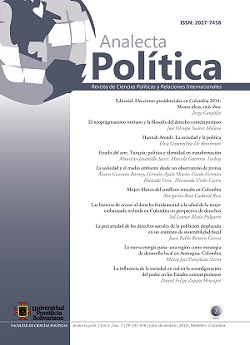
How to Cite
Article Details

This work is licensed under a Creative Commons Attribution-NonCommercial-NoDerivatives 4.0 International License.
Main Article Content
Abstract
Hannah Arendt is considered one of the most relevant political thinkers of the twentieth century. Her controversial position regarding some crucial political events of the century puzzled her readers, triggered fruitful discussions, and made it difficult to define Arendt as a political thinker. Her uncompromising thesis regarding the autonomous status of the political sphere led her to set a perplexing and unbridgeable gap between social demands and the political domain. In this context, I shall examine the position of Martin Jay and Maurizio Passerin D’Entrèves. fte first one defines Arendt as a political existentialist, whereas the latter more accurately posits her in the tradition of modern republican thinkers. By way of conclusion, I would like to suggest that a possible way to detach the Political from the Social, and submit its autonomous status, is to relate it to joyful activities.
References
Arendt, H. (1972). Crises of the Republic. San Diego, New York, London: A Harvest Book, Harcourt Brace & Co.
Arendt, H. (1982). Lectures on Kant’s Political Philosophy (Edited and with an Interpreta- tive Essay by Ronald Beiner). Chicago: The University of Chicago Press.
Arendt, H. (1993). Between Past and Future. Eight Exercises in Political Thought. New
York: Penguin Books.
Arendt, H. (1994a). Essays in Understanding 1930-1954. Formation, Exile, and Totali- tarianism (Edited and with and Introduction by Jerome kohn). New York: Schocken Books.
Arendt, H. (1994b). The Origins of Totalitarianism (New Edition with Added Prefaces). Orlando, Austin, New York, San Diego, London: A Harvest Book (HB244), Harcourt Inc.
Arendt, H. (1996). Ich will Verstehen. Selbstauskünfte zu Leben und Werk. (Herausgege- ben von Ursula Ludz). München, Zürich: Pieper Verlag GmbH.
Arendt, H. (1998). The Human Condition (with an introduction by Margaret Canovan). Chicago & London: The University of Chicago Press.
Arendt, H. (2001). Eichmann en Jerusalén. Un estudio sobre la banalidad del mal. Bar- celona: Lumen.
Arendt, H. (2003a). Was ist Politik? Fragmente aus dem Nachlass, München, Zürich: Pieper Verlag.
Arendt, H. (2003b). Responsibility and Judgment (Edited and with an Introduction by Jerome Kohn). New York: Schocken Books.
Arendt, H. (2006). On Revolution (with an Introduction by Jonathan Schell). New York: Penguin Books.
Aristóteles. (2001). Ética a Nicómaco. Madrid: Alianza.
Arendt, H. (2004). Política. Madrid: Tecnos.
Beiner, R. (1987). El juicio político. México: FCE.
Benhabib, S. (2000). The Reluctant Modernism of Hannah Arendt. Lanham, Boulder, New York, Toronto, Oxford: Rowman & Littlefield Publishers, Inc.
Canovan, M. (1995). Hannah Arendt. A Reinterpretation of her Political Thought. New York: Cambridge University Press.
Enegrén, A. (1984). La pensée politique de Hannah Arendt. París: Presses universitaires de France.
Habermas, J. (1977). Hannah Arendt’s Communications Concept of power. Social Re- search, 43 (4), 3-24 .
Hill, M. A. (Ed). (1979). Hannah Arendt: The Recovery of the Public World. New York: St. Martin’s Press.
Passerin, M. (1994). The Political Philosophy of Hannah Arendt. London and New York: Routledge.
Parekh, B. (1981). Hannah Arendt and the Search for a New Political Philosophy. London: The Macmillan Press.
Platón. (1998). República. Buenos Aires: Eudeba.
Similar Articles
- France K. L. Kgobe, Corruption in South Africa:A Clear Case of Seeing is Not Believing in an African National Congress-led Government , Analecta política: Vol. 15 No. 28 (2025): January-June
- Jorge Andrés Rico Zapata, Sebastián Díaz Bolívar, Dany Steven Gómez Agudelo, Public Opinion and Legitimacy: An Approach to Colombian Democracy , Analecta política: Vol. 15 No. 28 (2025): January-June
- Emma Turiño González, Mar Martínez Rosón, Ideology on Trial. Attitudes toward Sexual Politics among Latin American Legislators , Analecta política: Vol. 14 No. 27 (2024): July - December
- Cristhian Rivera Paredes, An Essay on the Modeling of Apparent Consensus Decision-Making within PublicInstitutions , Analecta política: Vol. 15 No. 28 (2025): January-June
- Javier Duque Daza, The Three Triads of Norberto Bobbio: Coordinates of His Thought and Works , Analecta política: Vol. 14 No. 27 (2024): July - December
- Eddison David Castrillón García, Paula Andrea Pérez Reyes, The context of structural violence in Colombia from the perspective of power struggles , Analecta política: Vol. 14 No. 27 (2024): July - December
- Andrés Felipe Pérez-Velasco, Anime as a Possibility for Public Policy in the Japanese Government , Analecta política: Vol. 14 No. 27 (2024): July - December
- Emre Aydilek, Does Türkiye Need a New Political Culture? Comparative Analysis of Political Culture of the United Kingdom and Türkiye , Analecta política: Vol. 14 No. 26 (2024): January - June
- Karen Miladys Cárdenas Almanza, Nino Angelo Rosanía Maza, Metaphors in political life. A study of the concepts of democracy and peace in the speech of Gustavo Petro Urrego , Analecta política: Vol. 13 No. 24 (2023): January - June
- Sara Piedrahita Sierra, The capture of institutions as an international phenomenon , Analecta política: Vol. 13 No. 25 (2023): July - December | Speech and memoirs
You may also start an advanced similarity search for this article.