
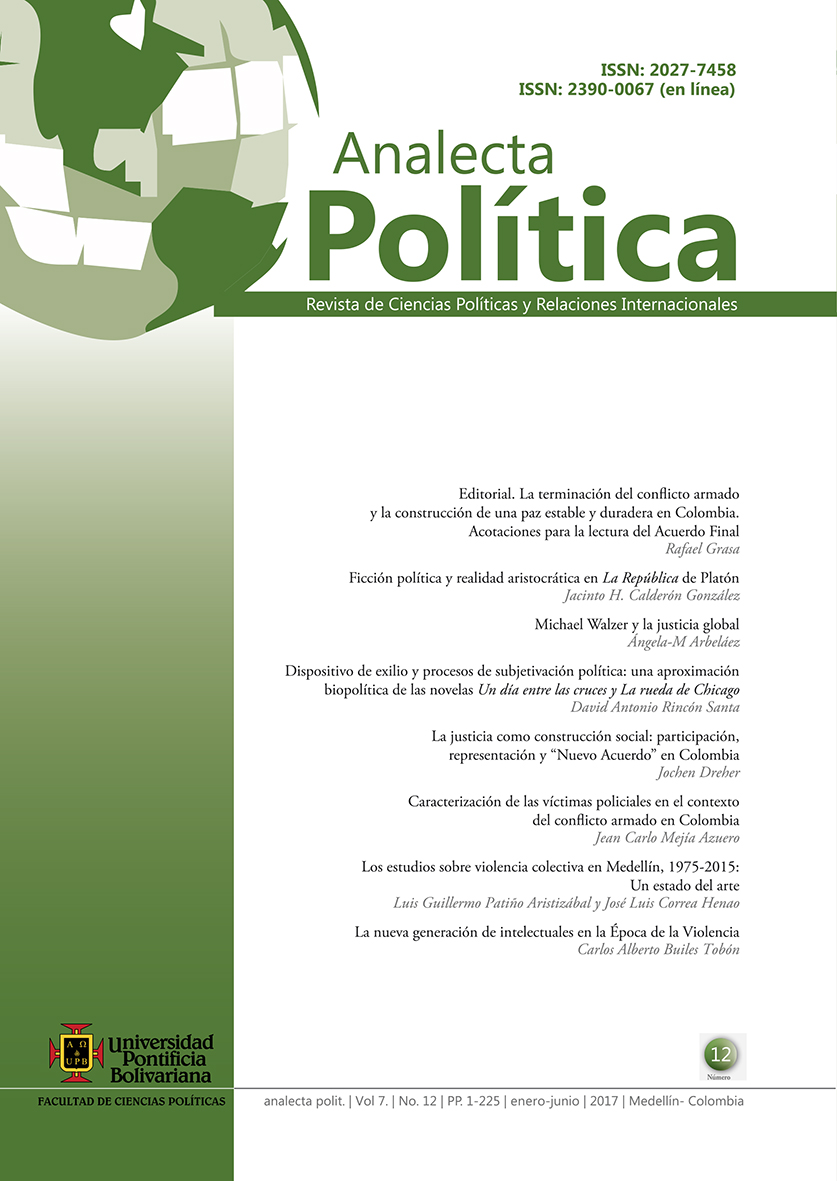
Ficción política y realidad aristocrática en La República de Platón
Barra lateral del artículo
Cómo citar

Esta obra está bajo una licencia internacional Creative Commons Atribución-NoComercial-SinDerivadas 4.0.
Descargas
Societal impact
Contenido principal del artículo
Resumen
El presente escrito quiere ofrecer una interpretación de la República de Platón atendiendo a aquellos elementos que ponen de manifiesto que, a la idea misma de pretensión de justicia, se le añade una realidad política basada en la aristocracia y en la diferenciación de los ciudadanos según una función a la que permanecen sometidos. A su vez, este artículo aborda la crítica de Pisarev a Platón en la medida que para aquél, Platón representa al típico gobernante dictatorial, pues para que el Estado funcione ha de comportarse como un organismo cualquiera, donde la razón modere y regule a la voluntad y a los apetitos los ciudadanos.
Detalles del artículo
Referencias
Eliade, M. (1991). Mito y realidad. Barcelona: Editorial Labor.
Gawoll, H. J. (1989). Nihilismus und Metaphysik. Entwicklungsgeschichtliche untersu- chung von deutschen Idealismus bis zu Heidegger. Stuttgart: Frommann – Holzboog.
Gil, L. (2007). Censura en el mundo antiguo. Madrid: Alianza Editorial.
Hegel, G. (2010). Fenomenología del espíritu. Madrid: Abada Editores.
¿Libertad para qué? (13 de mayo de 2008). Contando estrellas. Recuperado de http://www.outono.net/elentir/2008/05/13/%C2%BFlibertad-para-que/
Martínez, F. (2010). Historia de ha fihosofía I. Madrid: Istmo.
Nietzsche, F. (1997). La genealogía de la moral. Madrid: Alianza Editorial.
Nietzsche, F. (1998). Crepúsculo de los ídolos. Madrid: Alianza Editorial.
Pardo, J. L. (2004). La regha deh juego. Sobre ha dificuhtad de aprender fihosofía. Barcelona: Galaxia Gutenberg.
Platón (2007). Diálogos. Barcelona. Editorial Gredos.
Turguéniev, I. (1987). Padres e hijos. Barcelona: Editorial Planeta.